How to Grow a Fashion Brand (E-Commerce) in 2027
If you run an online clothing brand, you have probably felt it this year. The ads that used to bring in customers cost more and work less. Orders still come in, but growth has gone quiet, and nobody can quite explain why the old formula stopped working.
This piece is for founders who want to keep their website at the heart of the business and still grow. Inside, you’ll find how the winners think and a clear order of priorities you can apply to your own business model. You’ll also get a practical tool for managing expensive ads, and a guide to what to track inside the business so your decisions fuel growth.
Why instinct stopped being enough
Online growth used to be forgiving. A good product, a few strong ads and a welcome discount could carry a brand for years, even if nobody looked closely at the numbers.
Today, every part of that is more expensive and less predictable. Winning a new customer through paid social commonly costs $45 to $85 in clothing, platforms change their rules without warning, and duties on imported parcels have made landed costs harder to forecast. A small mistake in buying, pricing or spending now costs more and shows up faster.
The brands that coped with this shift did not necessarily have bigger budgets. They had better habits. Prioritise retention over acquisition.
How to make expensive ads pay for themselves
Every time an online brand wins a new customer through advertising, it makes an investment. It pays money upfront, and hopes that customer will return enough profit over time to justify the cost. Most founders never look at it this way, which is why so many keep spending on ads that never pay them back.
An investor would ask three questions before handing over that money. How much will this return, how long will it take, and what can I do to improve the result? Those same questions sit at the heart of healthy e-commerce growth.
This piece shows how to treat acquisition as an investment, how to measure the return through lifetime value, and how to manage your customer base so that every investment pays back faster. Add-ons and order value play a bigger role in that than most founders expect.
1. Treating the customer base as a core business asset
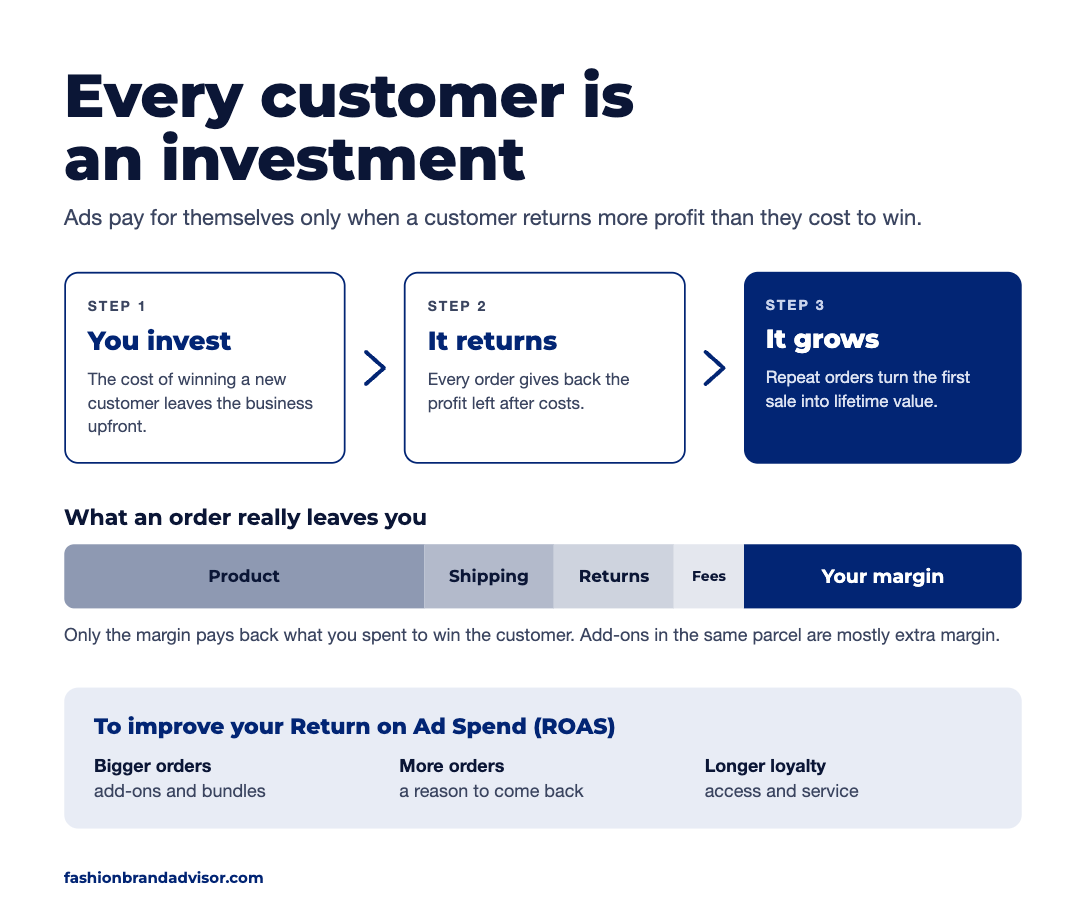
Customer acquisition cost is the total you spend to win one new customer. You calculate it by dividing your marketing spend over a period by the number of new customers it brought in.
Think of that figure as capital leaving your business. It goes out on day one, and it only comes back through the profit customers generate on their orders. Until it does, your brand is effectively lending money to its own growth.
This framing changes how you judge an ad. A campaign that brings in sales is only successful if the customers it wins eventually return more profit than they cost.
2. Measuring the return through Lifetime Value
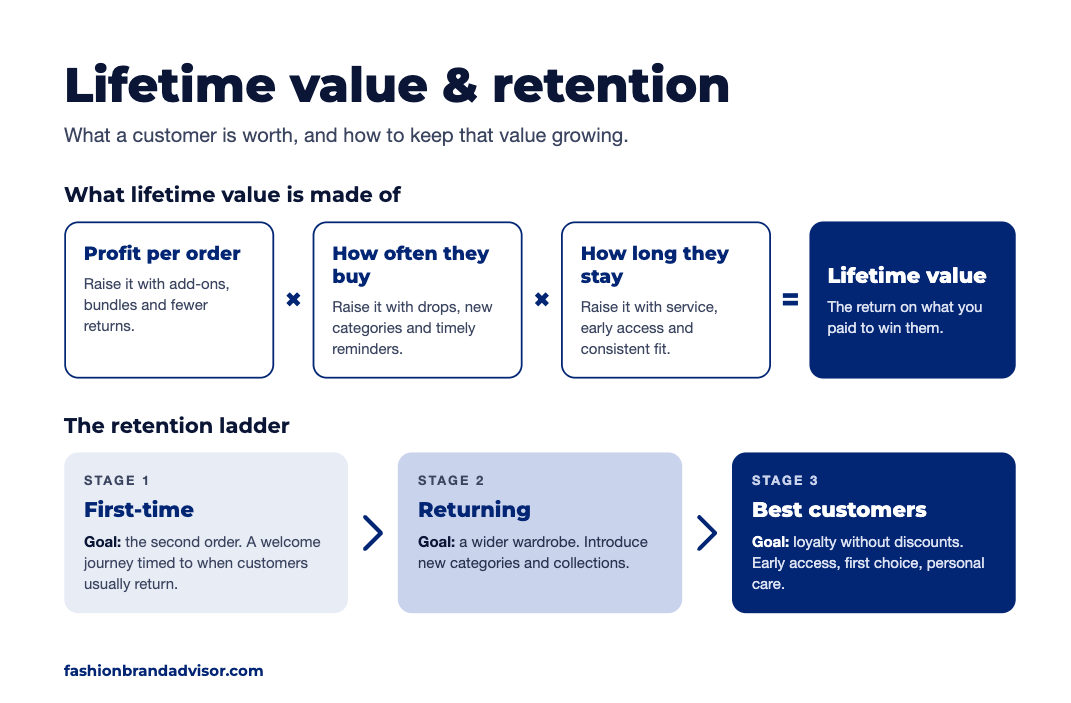
Lifetime value is the return on that investment. It is the total profit a customer brings your business over a set period, usually twelve months.
To calculate it, start with your contribution margin per order. This is what remains after you pay for the product, shipping, the average cost of returns and payment fees.
Next, take a group of customers who first bought in the same month and count how many orders they placed over the following year. Repeat the calculation at 90 days, 180 days and a full year to see how quickly the return builds.
3. Deciding how much a customer is worth paying for (calculating Customer Acquisition Cost (CAC))
Once you know the return, you can set a sensible price for each new customer. Most healthy brands aim for a lifetime value at least three times their acquisition cost.
The three-to-one ratio exists because contribution margin still has to cover your team, rent, software and samples, and leave you a profit.
4. Balancing the portfolio
Investors spread their risk, and brands should too. Your blended acquisition cost, which includes customers who arrive through word of mouth, creators, search and social posts, matters as much as the cost of customers from paid ads alone.
Organic and referred customers lower your average cost and make room for paid campaigns that would look expensive on their own. Keep paid acquisition within a ceiling set by your lifetime value, and track each source separately so a cheap channel does not hide an expensive one.
The ceiling should move with your results. When lifetime value rises, you can afford to spend more and grow faster than competitors. When recent groups of customers start returning less profit, pull back before the losses pile up.
Building add-ons into the Customer Journey
Shipping, packing and handling cost roughly the same whether a basket holds one item or three. That means a bigger basket is mostly extra margin.
The best add-ons complement the main purchase, carry high margins and come in one size, which protects you from the fit problems behind most fashion returns. Belts, scarves, socks, jewellery, bags, garment care and gift wrapping all fit this description.
Each stage of the journey suits a different kind of offer:
On the product page, a “complete the look” section helps customers picture the outfit and add pieces they had not planned to buy.
In the basket, one relevant suggestion works well alongside a progress bar showing how close the customer is to free shipping.
At checkout, a single small item such as a care kit keeps the decision effortless and protects conversion.
After payment, a one-click offer on the confirmation page adds value without putting the original sale at risk.
In the following weeks, post-purchase emails can introduce the next category, turning a single purchase into a wardrobe.
Bundles and multipacks raise order value by shaping what customers choose from the start. Price them so the set still earns a healthier margin than the items sold separately, and keep any free-shipping threshold close enough to your current average order that customers can reach it with one addition.
Managing the customer base
Investors review their holdings regularly, and your customer list deserves the same attention. Most brands treat all customers alike, which wastes money on some and neglects others.
Divide your list into a few clear groups and give each one a purpose:
First-time customers are the most important group to move. The second purchase is where most acquisition costs finally start to pay back, so build a welcome journey timed around the average number of days it takes your customers to order again.
Returning customers have shown they like the brand. Introduce them to new categories and collections, because customers who shop across categories tend to stay longer.
Your best customers, often the top fifth of your list, usually drive a large share of repeat revenue. Reward them with early access, first choice on new pieces and personal attention, so their loyalty never depends on discounts.
Customers at risk have passed the point when they would normally buy again. Reach them with something genuinely relevant before they drift away completely.
Lapsed customers have not bought in a long time. Try a thoughtful win-back message, and if they still do not respond, stop spending money trying to reach them.
Reformation shows what a well-managed customer base can achieve. Last year, 70% of its revenue came from returning customers, and about three-quarters of its online revenue came from people who bought in more than one category.
Adapting the approach to your business model
The investment logic applies to every online fashion brand, but the emphasis changes with the business model.
Brands selling everyday essentials earn most of their return through frequency, so multipacks, replenishment and repeat reminders matter most. Brands built on seasonal collections earn it through customers returning for each new range, so launch calendars and early access carry the weight.
Brands built on limited drops depend on how many customers return for every release, so community and anticipation drive lifetime value. Premium and made-to-order brands may recover their acquisition cost on the first order, and they grow lifetime value through service, add-on services such as tailoring or monogramming, and personal recommendations.
The strategy behind profitable growth
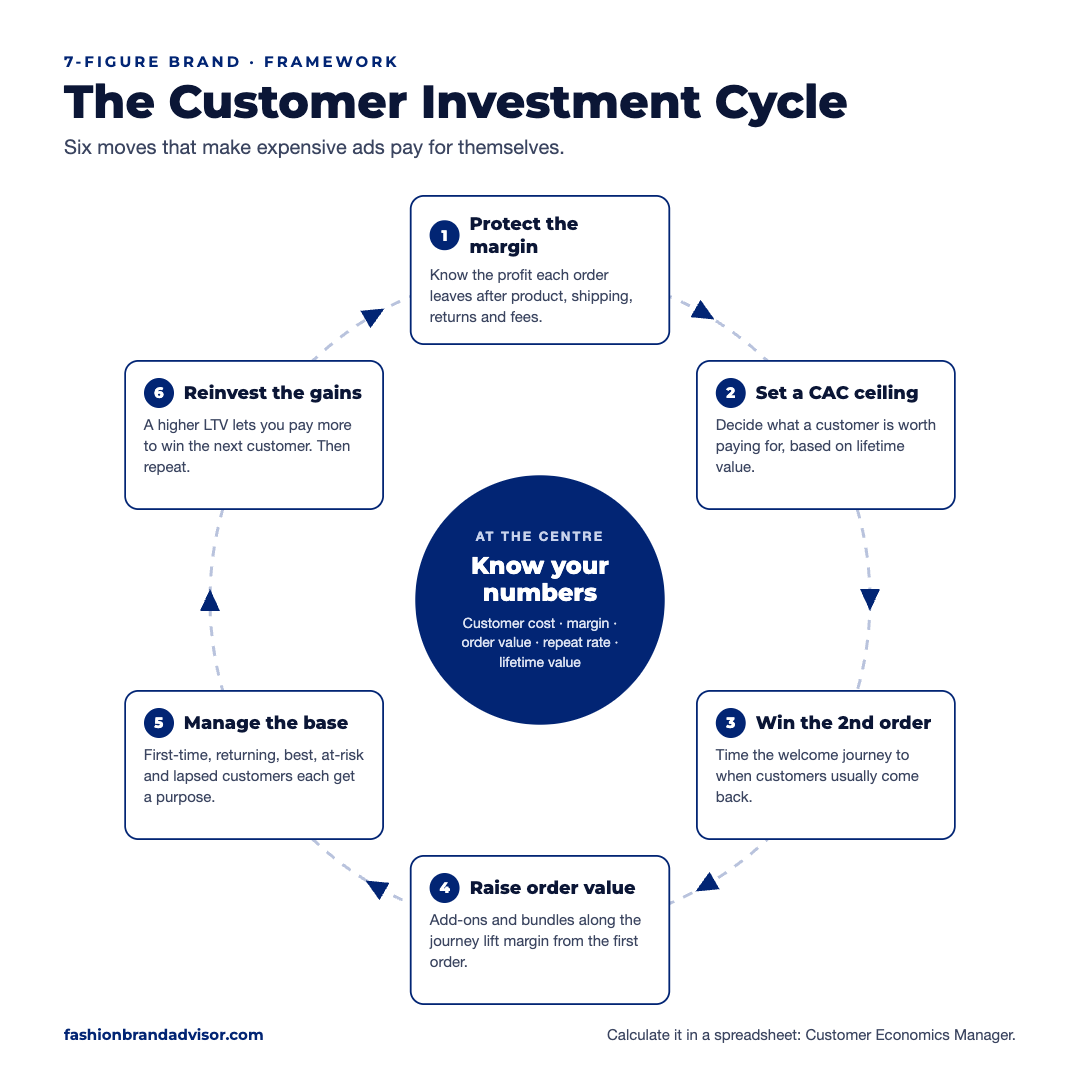
The brands that grow through expensive advertising will manage customers the way good investors manage capital. They will know the return on every customer, set a clear limit on what they will pay, and work every month to make each investment pay back faster.
Build this in a deliberate order. First, protect the contribution margin on every order. Then set your acquisition ceiling from real lifetime value data, invest in the journey to the second purchase, and raise order value with add-ons that genuinely help customers.
Finally, reinvest what you gain. Each improvement in order value, repeat purchases or retention raises what a customer is worth, which lets you spend more to win the next one. That cycle, repeated month after month, is how an online brand turns expensive ads into a growth engine it can rely on.