The EU Is Making Fashion Harder. Are You Prepared?
If you run a fashion brand, you are already dealing with enough. Consumers are more cautious, production is rarely as predictable as founders would like, and every new collection carries a significant amount of cash-flow risk before you know how customers will respond.
Now there is another factor entering the equation: EU fashion regulations.
In this article
What’s changing in the EU and which regulations matter
How they affect your business
What EU and non-EU brands need to know
What you should do now to be prepared
You can spend months building a collection, putting your savings, your time and your reputation behind it, and still discover that the numbers no longer work as you expected.
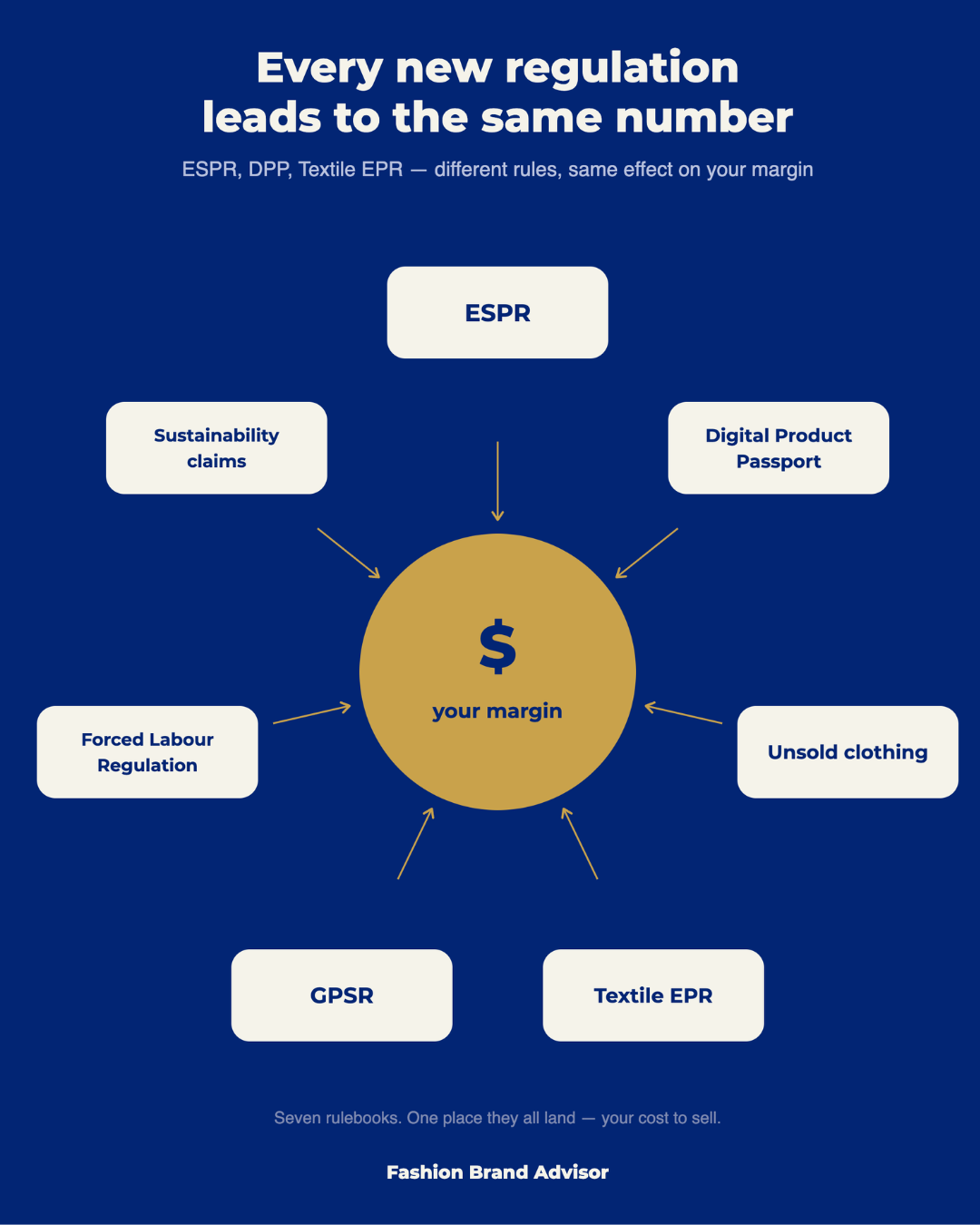
That is the uncomfortable part of what is happening in Europe. New EU rules are reaching into product design, supplier information, inventory, waste, product safety and the cost of selling. For brands based in the EU, this can change how products are designed, documented, produced and managed. For brands outside the EU, selling into Europe can mean taking on new responsibilities, compliance costs and operational decisions that directly affect the profitability of entering the market.
And these costs can appear long before a customer ever sees the product.
For a founder already carrying the risk of production, stock and cash flow, discovering a new requirement after the money has been committed can be expensive.
The EU is changing the economics of fashion for brands inside and outside Europe. If Europe is part of your market, the time to understand what these changes mean for your margins is before your next collection, not after.
This article explains what is changing, what it means financially, and the practical framework I would use to prepare a fashion brand for the next phase of EU regulation.
What you need to know about EU fashion regulations in 2026
The most important developments are not happening in isolation. Several areas of EU regulation are moving in the same direction: asking businesses for more information about products, materials, suppliers, environmental performance and what happens to products after they are made.
For a fashion founder, that creates a common business question: can you reliably produce, store and access the information behind every product you sell?
The individual rules are different, but they increasingly depend on the same underlying business infrastructure. You need reliable product information, better supplier visibility, stronger inventory management and a clearer understanding of the economics of every market you sell into.
That is why EU sustainability regulations and fashion business costs need to be considered together.
What the research actually tells us:
Product regulation is moving upstream
The Ecodesign for Sustainable Products Regulation (ESPR) creates a framework for improving the environmental performance of products placed on the EU market. Textiles and apparel are among the priority product groups, and the European Commission's current working plan places textiles in the 2027 implementation window. The Commission indicates planned adoption of the textile-specific ESPR delegated act in Q4 2027, although timelines can evolve as the legislative and technical work progresses.
The final textile requirements are therefore still being developed, but the direction of travel is already clear. Product characteristics such as durability, repairability, recyclability, resource efficiency and product information are becoming increasingly important within the European regulatory framework.
For fashion founders, that means some decisions that have traditionally sat entirely within product development and merchandising may increasingly have financial and regulatory consequences. The question is no longer only whether you can make a particular product at your target cost. You also need to consider whether the product, its materials, its construction and its supporting information will allow you to sell it efficiently in the markets you want to serve.
That can influence fabric selection, construction, supplier choice, product development timelines and ultimately your margin.
The Digital Product Passport makes product data a business issue
The Digital Product Passport for fashion is another major development. The European Commission is introducing the DPP progressively across product groups, and textile apparel is one of the priority categories under the ESPR working plan. The Commission currently indicates planned adoption of the textile-specific delegated act in Q4 2027.
The technology itself is not the biggest challenge for most emerging fashion brands. The harder question is whether the information behind the passport actually exists and can be accessed reliably.
Depending on the final textile requirements, relevant product information may include product identification, fibre composition, origin, information supporting repair and maintenance, end-of-life information and identification of relevant economic operators. The exact requirements will be defined through the future delegated act and technical specifications.
That means founders should start thinking about product data much earlier than the point at which a QR code or digital interface is required.
For every important SKU, you should be able to answer basic questions such as:
If this information is spread across supplier emails, spreadsheets, WhatsApp messages and individual people's memory, the problem is bigger than future DPP compliance.
It means your business does not yet have a reliable product information system.
And that affects much more than regulation. The same information is needed for costing, sourcing, production, wholesale, sustainability claims and increasingly for understanding the profitability of individual products.
Unsold inventory is becoming a financial and regulatory issue
One of the clearest examples of regulation moving into fashion business economics is the EU's new restriction on destroying unsold clothing.
From 19 July 2026, large companies across the EU are prohibited from destroying unsold clothing, clothing accessories and footwear. Medium-sized companies will become subject to the same prohibition from 2030. The European Commission also requires businesses to prioritise alternatives such as selling, donating, repairing, refurbishing or preparing products for reuse.
There are limited exceptions, including certain cases involving safety, damage, counterfeit goods or products that are unsuitable for reuse. Businesses relying on these exceptions need supporting evidence and records.
The European Commission estimates that between 4% and 9% of textile products placed on the European market are destroyed before use.
For fashion founders, the bigger issue is what this tells us about inventory economics.
Excess inventory has always been expensive. It ties up cash, creates storage and handling costs, increases markdown pressure and can force founders into increasingly aggressive discounting simply to recover some of the money invested in the collection.
As disposal becomes more restricted, the financial consequences of producing too much become even more important.
This is why the EU unsold clothing ban should be viewed as an inventory-management issue as much as a sustainability regulation.
The numbers you should be watching:
The important shift is from asking, “How much did we sell?” to asking, “How much cash did this collection generate after the cost of producing, holding, discounting and returning the inventory?”
That is a much more useful question for making informed decisions as a founder.
What does textile EPR mean for Fashion Brands?
The revised EU Waste Framework Directive introduces common rules around textile Extended Producer Responsibility (EPR). Member States will establish national EPR systems, with producers contributing financially towards the collection, reuse, recycling and disposal of textile products.
The exact implementation and fees can vary between countries, which is particularly important for brands selling across several European markets.
This matters because the cost of selling a fashion product is becoming broader than the factory price.
A traditional product-costing calculation might look like:
Fabric + trims + labour + packaging + freight = product cost
But when you are evaluating the economics of selling into a European market, you increasingly need to consider the wider cost structure:
Manufacturing + freight + duties + EPR + compliance + fulfilment + returns + markdown risk = true cost of selling
That does not mean every product will suddenly become unprofitable.
It means you need a more complete view of product and market economics before making pricing, sourcing or expansion decisions.
European and Non-European Fashion Brands face different operational questions
One of the most important things to understand about EU regulations for fashion brands is that being headquartered outside Europe does not automatically remove a brand from the European regulatory environment.
What matters is whether your products are being placed on the EU market and which requirements apply to your particular products and business model. The European Commission's DPP guidance, for example, states that obligations apply to economic operators placing products within the scope of relevant EU legislation on the Union market, whether those products are manufactured domestically or imported.
For a European brand, this means adapting systems that are already operating inside the EU market.
For a non-European brand, the challenge can be broader because Europe may require an additional layer of market-entry infrastructure.
This is why I would encourage non-EU founders to stop thinking about Europe simply as another sales channel.
You need to understand whether the market works financially after you include all the costs associated with serving it.
What should Non-EU Fashion Brands calculate before entering Europe?
For a brand based in the UK, US, Asia or another non-EU market, “selling in Europe” should not simply mean switching on international shipping on your website.
Before entering the market, you should understand the economics and operational requirements of doing so.
The important question is not simply:
“Can we sell in Europe?”
It is:
“At what sales volume and margin does selling in Europe make sense?”
That question belongs in your financial model before you invest heavily in market expansion.
Supply-chain transparency is becoming a commercial capability
Another important development is the EU's increasing focus on supply-chain transparency and responsible sourcing.
The EU Forced Labour Regulation will prohibit products made with forced labour from being placed on the EU market, made available on it or exported from the EU from 14 December 2027.
This does not mean that every small fashion brand suddenly has to produce a huge annual audit report. It does mean that founders need to understand their supply chain well enough to identify risks and respond when questions arise.
At a minimum, you should be able to map:
Brand → Factory → Fabric supplier → Raw material → Key processing stages
If your factory cannot tell you where a key material came from, or your supplier cannot provide basic supporting information, you have a visibility problem.
That problem can affect compliance, but it can also affect production continuity, sourcing decisions, sustainability claims and your ability to respond to wholesale or customer requirements.
Supply-chain transparency is therefore becoming a commercial capability, not simply a compliance exercise.
Sustainability claims need evidence
The same principle applies to sustainability marketing.
If your website says that a product is made from recycled materials, uses organic fibres, is made in a particular country, contains recycled packaging or has a particular durability or repairability characteristic, you should be able to explain what evidence supports that claim.
The practical solution is to connect each claim to supporting documentation rather than allowing sustainability information to become disconnected from the product itself.
Again, the benefit goes beyond compliance.
When this information is organised properly, your marketing team, product team, buyers and customers can work from the same information. You reduce the risk of making unsupported claims and make it easier to answer questions when they arise.
A simple test: could your business handle a new EU requirement?
Imagine that tomorrow you discover a new requirement applies to one of your product categories.
Could you identify the affected SKUs quickly? Could you tell which suppliers and factories are involved, what materials are used and where they were produced? Could you access the supporting documentation without searching through hundreds of emails?
More importantly, could you calculate what the change would do to your product cost and margin?
You should be able to answer questions such as:
If answering these questions requires several weeks of searching through spreadsheets and supplier emails, the underlying problem is your business infrastructure.
That is exactly why the current wave of EU sustainability regulations for fashion is bigger than a compliance conversation.
It is exposing where fashion businesses have weak data, weak inventory controls and weak financial visibility.
What I would do now if I were running a Fashion Business
You do not need to overhaul your entire business tomorrow. Start with the areas that create the greatest financial exposure.
→ Audit your product data. Choose your top-selling and highest-value SKUs and check whether you can access the material, supplier, production and certification information you already have. You may find that the information exists, but is fragmented across several systems.
→ Analyse your inventory. Identify your slowest-moving products and calculate how much cash is currently tied up in them. Look at the age of the inventory as well as the total value, because two businesses can hold the same amount of stock while carrying very different levels of risk.
→ Map your supply chain. Start with your most important products and work backwards from the finished product to the key materials. You do not need to solve the entire supply chain in one month. Build the visibility progressively.
→ Recalculate your European contribution margin. If you sell into Europe, do not rely on your standard product margin. Include the costs associated with fulfilment, returns, duties, EPR, compliance and the working capital required to support the market.
→ Build a regulatory calendar. Track what applies today, what is coming next, which products are affected and who inside the business is responsible for responding.
→ Build compliance into your operating system rather than creating a separate compliance exercise. The strongest systems will be the ones that make your business easier to run every day, not simply the ones that help you tick a regulatory box.
The bigger opportunity
There is a temptation to see EU regulation as another burden placed on already stretched fashion founders.
Some of these changes will create additional costs. Some will require more information, more documentation and better processes.
But there is another side to this.
The same systems that make regulatory compliance easier can make your business more profitable and easier to manage.
Better product data improves costing. Better inventory visibility improves cash flow. Better supplier mapping reduces production risk. Better market-level economics improve expansion decisions. Better documentation makes wholesale and sustainability conversations easier. Better forecasting reduces overproduction.
That is why I would not recommend approaching EU fashion compliance as a separate legal project.
Treat it as an opportunity to strengthen the infrastructure underneath your business.
Your next collection should be easier to manage than your last one
Before you approve your next collection, ask yourself five questions.
Do I know the real economics of every SKU? This means understanding the margin after the costs that actually occur when you produce, sell, fulfil, return and potentially mark down the product.
Do I know how much cash is tied up in inventory? You should be able to identify slow-moving stock early enough to make decisions before it becomes a much bigger problem.
Can I access reliable product and supplier data? If basic product information requires a long search through emails and spreadsheets, your systems are already creating operational risk.
Do I know the true cost of selling in every market? This becomes particularly important when you are expanding into Europe or selling from outside the EU.
Could my business adapt if a new regulation affected one of my products? If the answer depends on rebuilding your systems from scratch, the problem is bigger than compliance.
What this means for you as a Founder
You do not need to predict every EU regulation. But you need to understand where regulation touches your economics: product, inventory, suppliers, market expansion, margins, cash.
The direction of travel is clear: EU regulation is increasingly connected to the information and systems behind the products you sell. The European Commission's own implementation work around ESPR and the Digital Product Passport is built around more accessible, structured product information, while the new unsold-goods rules directly connect product lifecycle decisions with how businesses manage inventory.
For founders, the opportunity is to prepare before a new requirement becomes urgent.
The brands that do this well will have more options when the market changes. They will be better positioned to change suppliers, adjust products, review markets, protect margins and make inventory decisions from actual data rather than reacting under pressure.
The goal is not simply to stay compliant.
The goal is to build a fashion business that can adapt without every regulatory change becoming a financial emergency.
Where does your business stand?
EU regulation is only one part of the financial pressure facing fashion brands.
If you do not have clear visibility over your SKU profitability, inventory, cash flow and market economics, it becomes much harder to understand what regulatory changes will actually cost your business.
That is where I would start.
Before worrying about every regulation coming over the next few years, understand where your business is financially exposed today, which areas could become more expensive, and what systems you need to put in place to give yourself more control.
Book a free 15-minute clarity call to talk through where your business is now, where the financial pressure is coming from, and what needs to change next.