How Coach Is Winning the Cautious Consumer
Fashion is getting harder to sell. Consumers are becoming more selective about discretionary spending, looking for greater value, while tariffs and rising costs are putting further pressure on fashion brands' margins. At the same time, the way customers discover and decide what to buy is changing, making brand relevance increasingly difficult to maintain.
So what does it take to keep growing when customers have more reasons to hesitate?
In this article, we look at Coach's recent growth to understand what is happening underneath the revenue number, and what independent fashion founders can learn from it.
You'll see why strong demand, new customer acquisition, pricing power, product focus and full-price sales are becoming increasingly important, and how ignoring these signals can leave a brand growing revenue while quietly losing margin, tying up cash in inventory and becoming more dependent on discounts.
Most importantly, you'll learn what you can do to tell whether your brand is actually getting stronger, and which actions can help you build more resilient growth.
Fashion consumers are becoming harder to convince.
After several years of inflation and economic uncertainty, shoppers are paying closer attention to what they buy and how much they spend. McKinsey's latest consumer research shows discretionary spending is under pressure, with consumers reporting particularly weak spending intentions in all fashion categories including accessories and jewellery.
The reasons are familiar. Household budgets have been squeezed by higher prices, while uncertainty around the economy, employment and the wider geopolitical environment makes consumers more careful about discretionary purchases. At the same time, fashion companies are dealing with rising costs across their own supply chains. McKinsey estimates that tariffs have increased apparel and leather-goods prices by roughly 35% from a first-cost perspective, adding further pressure to the industry.
The result is a consumer who still spends, but thinks harder before spending.
The latest results from Tapestry offer an interesting case study of what this means for fashion brands.
Coach grew revenue by 24%, reaching $6.9 billion.
While Kate Spade, which sits within the same parent company, had a very different year. Revenue declined 10% to $1.07 billion, including a 7% decline in the past quarter.
(Budrul Chukrut/SOPA Images/LightRocket/Getty Images)
Both brands operate within the same broader fashion market. Both sell handbags and accessories. Both are dealing with a consumer who has become more selective.
Their results show what can happen when a brand continues to create strong demand while consumers are becoming more deliberate about where they spend.
For independent fashion founders, there is a useful lesson here.
In a cautious market, relevance matters more.
“In a cautious market, relevance matters more.”
The market is making customers harder to win
(The resourceful consumer: Sustained price pressure leads to savvier spending/ McKinsey: State of the Consumer 2026)
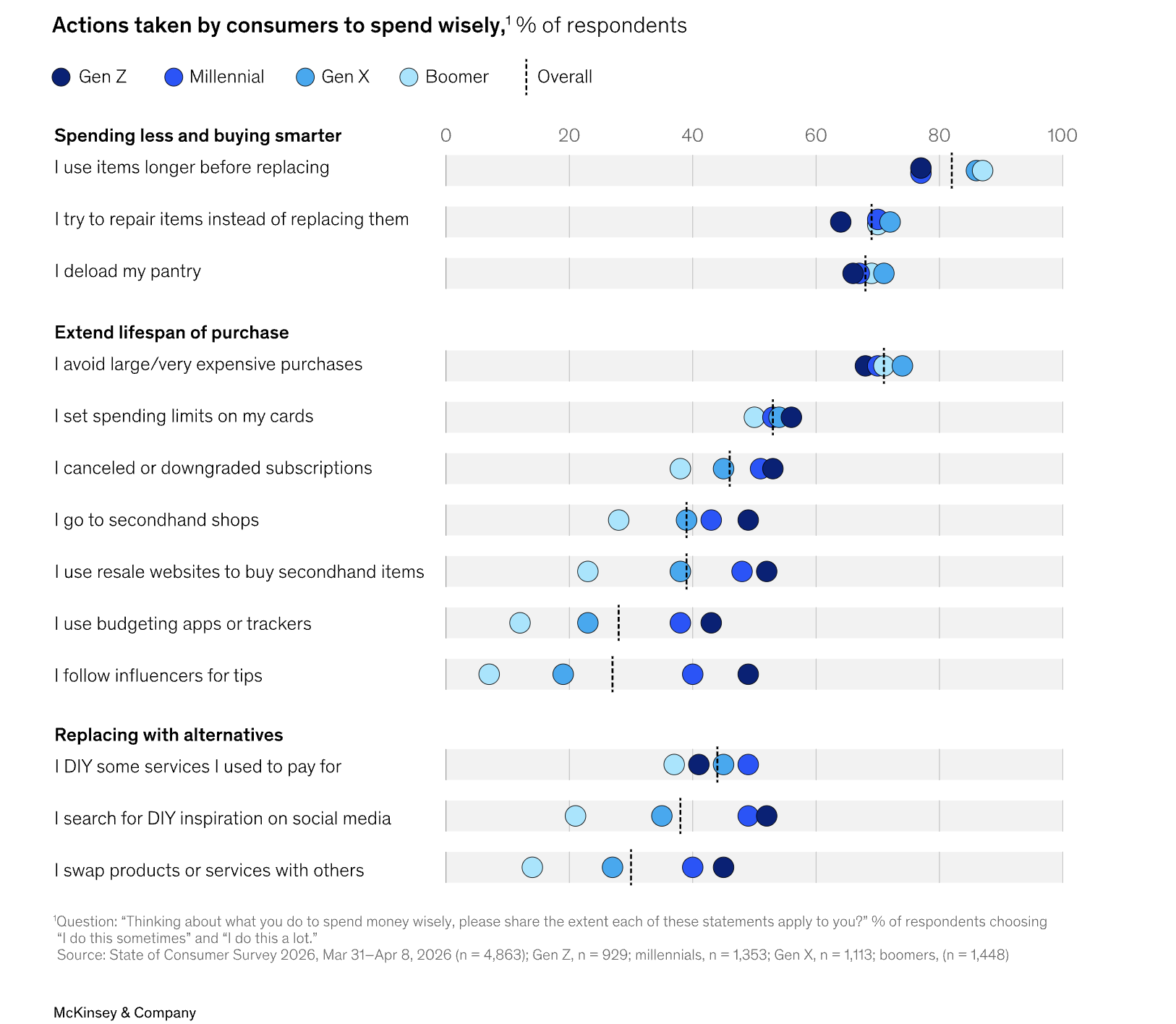
The fashion industry entered 2026 expecting another period of modest growth and continued volatility. The BoF-McKinsey State of Fashion 2026 identifies economic volatility, changing consumer priorities and shifting trade conditions among the forces reshaping the industry. Consumers are rethinking their spending and looking for greater value from their purchases.
This changes the way consumers evaluate fashion.
A handbag, coat or pair of shoes is still a discretionary purchase. When household budgets are under pressure, consumers can postpone the purchase, choose a cheaper alternative or spend their money elsewhere.
That means every purchase has to earn its place in the customer's budget.
Price is part of that decision, but it is only one part.
Consumers can still spend on products they consider worth it. McKinsey's research shows that consumers continue to make room for purchases that offer quality, value or meaning, even while remaining financially cautious.
This creates a difficult environment for fashion brands.
A brand has to give customers a sufficiently strong reason to buy while also maintaining an economic model that can withstand higher costs.
Coach's recent performance suggests that it has managed to do that.
Tapestry says Coach added approximately 9 million consumers during fiscal 2026. Across the group, around 11 million new customers were acquired, with approximately 35% of those new customers coming from Gen Z.
That is significant because customer acquisition tells us something that revenue alone cannot.
A brand can increase revenue by raising prices or selling more frequently to its existing customers. Bringing millions of new customers into the brand indicates that demand is expanding.
For an independent fashion founder, this raises a simple question:
Who is becoming a customer of your brand this year who was not a customer last year?
If the answer is unclear, growth may be relying too heavily on the same customer base.
Relevance has to show up in the product
Coach's performance has been closely connected to its handbags and leather goods. Products including the Tabby and other key handbag lines have continued to support the brand, alongside investment in product innovation and brand building.
There is an important lesson here for smaller brands:
When sales slow down, the instinct is often to create more products.
A new collection can feel like a fresh opportunity to generate demand. More colours, more silhouettes and new categories give marketing teams something new to promote.
They also increase the amount of cash tied up in inventory.
Every additional SKU requires development, sampling, production, storage and marketing. If the product does not generate sufficient demand, the cost remains with the business.
Before adding more products, a founder should understand which existing products are actually creating demand.
Which SKU brings in new customers?
Which one sells consistently at full price?
Which one has the strongest contribution margin?
Which products repeatedly require markdowns?
Which product is becoming recognisable as part of the brand?
Your answer may tell you more about the future of the business than the performance of the entire collection.
Pricing power is becoming more important
One of the most interesting details in Coach's results is what happened to average selling prices.
Tapestry reported that Coach's average unit retail price increased by a mid-teens percentage rate in its core leather goods business, while units declined by a low double-digit rate. The company also highlighted lower markdowns.
The financial implication is significant.
A brand can generate more revenue without increasing unit volume at the same rate when customers are willing to pay more.
That is pricing power.
For an independent brand, pricing power can have an even greater impact because smaller businesses have less room to absorb rising production, logistics, marketing and operating costs. This is particularly relevant now.
You, as a founder should also know:
Average selling price
Full-price sell-through
Gross margin by product
Contribution margin by product
Markdown rate
Revenue per customer
Repeat purchase rate
These metrics explain what is happening underneath the revenue number.
Discounting can tell you something about demand
Kate Spade's recent performance also highlights the difficulty of relying on promotions to stimulate sales.
Earlier in fiscal 2026, Tapestry said Kate Spade's revenue decline was partly connected to a strategic pullback in promotions. The brand has been working on customer experience, creator activations and brand relevance as part of its turnaround.
This is an important distinction for any fashion founder.
Promotions can produce sales quickly. But, they can also make it difficult to understand the real level of demand for a product.
If a product sells at 30% off, the transaction tells you that someone wanted the product at that price. It does not necessarily tell you that they wanted it at full price.
That difference affects your margin, your forecasting and your inventory decisions.
A metric to monitor is full-price revenue as a percentage of total revenue.
If revenue is increasing while full-price revenue is falling, the quality of that growth deserves closer examination.
If revenue is flat while full-price sell-through is improving, the business may be developing stronger fundamentals than the headline figure suggests.
Your next customer may be different from your current customer
Coach's customer acquisition also points to a broader question that every growing brand needs to answer.
Who is your next customer?
Tapestry has been particularly focused on Gen Z. Around 35% of the group's new customers in fiscal 2026 were Gen Z, and Coach has been one of the strongest brands in the portfolio at attracting younger consumers.
An independent brand does not need to copy that strategy.
The useful exercise is to understand where your next stage of growth will come from.
The customer who gets you from $100,000 to $250,000 in annual revenue may not be the same customer who gets you from $250,000 to $1 million in current economy.
That has implications for your product, pricing, positioning, distribution and marketing.
You should be able to answer four questions clearly:
Who buys from us today?
Who do we want to attract next?
Why would that customer choose us?
Does our current brand give them a strong enough reason to do so?
If those answers are unclear, increasing marketing spend may simply make the same positioning problem more expensive.
Growth needs to improve the economics of the business
This is where the Coach story becomes particularly relevant to an independent fashion company.
Revenue growth is useful. The quality of that growth matters more.
When a brand grows, you want to know what happened to the underlying economics.
Coach's recent results show several of these factors moving in the right direction at the same time. The brand grew its customer base, performed strongly in core product categories, increased average selling prices and reduced markdowns.
That combination creates a stronger foundation for growth. It also provides a useful framework for smaller brands.
The lesson is to understand what is creating demand inside your own business
Before planning the next collection or increasing your marketing budget, look at five numbers.
1. Full-price sell-through
How much of your collection sells without a discount?
2. Average selling price
Are customers becoming more willing to pay for your products?
3. Markdown rate
How much revenue are you giving up to generate sales?
4. Revenue concentration by SKU
Which products are actually carrying the business?
5. New versus returning customers
Are you expanding your customer base, or are you repeatedly selling to the same customers?
Together, these numbers give you a much clearer picture of the health of the brand.
The bigger lesson
Coach's performance is a useful reminder that brand strength eventually appears in the financials.
→ When customers strongly want a product, the brand has more room to protect its price.
→ When a product has strong demand, inventory can work harder.
→ When new customers continue to enter the brand, growth has a stronger foundation.
→ When customers buy without heavy promotional support, more of the revenue can become profit.
This matters particularly in the current market.
Consumers are facing higher living costs and continued economic uncertainty. Fashion companies are facing higher input costs and greater trade complexity. Discretionary spending is therefore being scrutinised more carefully, and consumers are looking for stronger reasons to make a purchase.
The brands with a clear proposition, strong demand and disciplined financial model have more options.
Your revenue tells you how much you sold. Your financial metrics tell you whether the brand is becoming stronger.
That is the standard I would use when evaluating growth.
The goal is to build a business where revenue, demand and profitability improve together.
Want to know what is really driving your brand's growth?
Revenue can tell you whether you are growing. It cannot tell you whether that growth is healthy.
Get a clearer view of what is working, what is holding your brand back, and where to focus next.