“Just do it”.
If you've spent any time around business coaches, you've heard it. Stop overthinking. Stop planning. Just start.
And honestly? It works, at first. If you're frozen, action is the cure. You launch the drop, post the reel, email the stockist. You feel like a founder again.
Then something doesn't land. Sales are slow, or the wholesale buyer goes quiet, or the ads eat your margin. So you change direction. New product, new channel, new customer. Six months later, it happens again.
Two years in, you're on your fourth relaunch. You've worked incredibly hard. And somehow you feel like you're standing exactly where you started.
That feeling has nothing to do with talent or work ethic. It's a structural problem. And it has a structural fix.
Starting over vs. building on
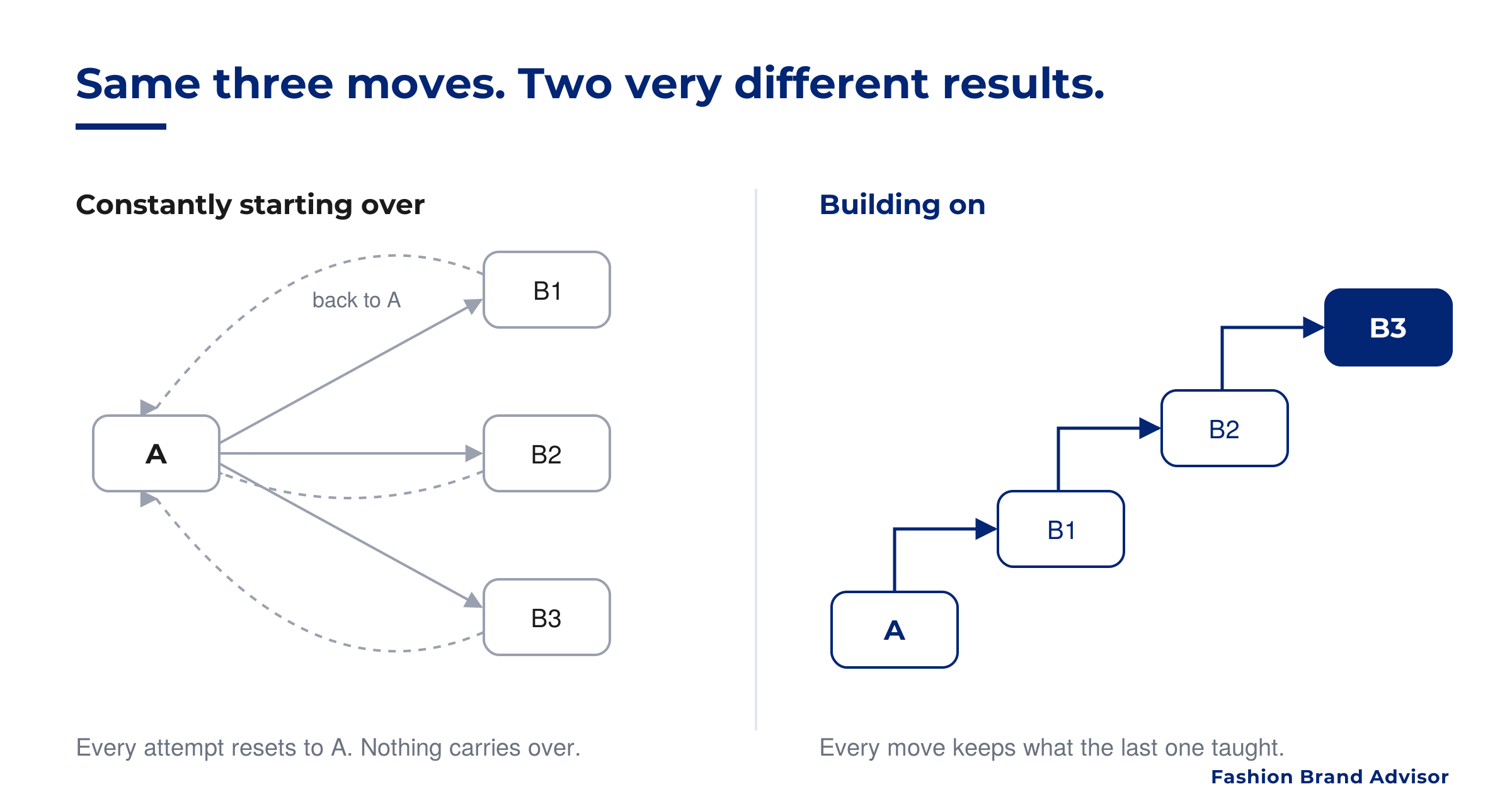
In both pictures, the founder tries the same three things.
On the left, every attempt goes back to A. B1 doesn't work, so they return to square one and try B2. Then B3. A year of hard work, and they're still at A.
On the right, each move starts from the last one. B2 keeps what B1 taught: the customer, the price point, the supplier. B3 builds on both.
Same effort. Same number of pivots. A completely different place at the end.
Why smart founders keep resetting
When you start with no plan at all, you're improvising. That's fine. Every founder improvises at the beginning.
The problem shows up when something fails. If you never wrote down what you expected, you have nothing to compare the result against. All you're left with is a feeling: this didn't work.
And a feeling doesn't tell you what to keep. Was it the product? The price? The channel? The timing? You can't tell, so you throw out all of it and go back to A.
That's why the founders who reset most are often the most action-oriented ones. They move fast. They just don't leave themselves anything to build on.
The opposite trap is just as real. Plan every step in detail and you freeze, because no plan survives contact with real customers, and you know it. So the question isn't plan or don't plan. It's what kind of plan.
Plan scenarios, not just steps
Scenario planning sits between the two traps. You don't map every step. You decide, before you start, what you'll do depending on what happens.
It takes one page and four questions:
What is A? The move you're making now, and what you expect it to prove.
What are the likely outcomes? Usually two or three. It works, it half-works, it doesn't.
What's the signal for each? A number or an event you'll be able to see, with a date. Not a feeling.
What's the next move in each case, and what carries over? This is the part most founders skip, and it's the part that stops you starting over.
That's it. You still improvise. You still pivot. But now each pivot has a reason, and it starts from what you learned rather than from zero.
This is also where the discipline comes from. It's much easier to stay focused on A when you already know what you'll do if A doesn't work. The overwhelm goes, because the decision is already made.
What this looks like for a first drop
Say A is a first drop of 6 styles, sold direct-to-consumer through Instagram and your own site. What you expect it to prove: that people who aren't your friends will pay full price.
Before launch, you write this down:
Optimist scenario: It sells
Signal by day 45: 70%+ of stock sold at full price
Next move: Reorder the two best sellers, deepen sizes, test one new style
What carries over: The customer, the price point, the factory
Realistic scenario: It half-sells
Signal by day 45: 30-70% sold, two styles carrying the rest
Next move: Cut the slow styles, build the next drop around the winners
What carries over: The winning styles, the customers who bought, the content that converted
Pessimistic scenario: It stalls
Signal by day 45: Under 30% sold, little repeat interest
Next move: Change one cheap lever first: the message, the audience or the offer. Test a new channel only if you can afford it
What carries over: The product learnings, the supplier, the cost structure, the stock
Example numbers. Set your own thresholds from your margins and stock levels.
Look at what carries over. Even in the worst case, you're not going back to A. You're keeping the supplier relationship, the costings and everything you learned about the product. You're changing one lever, not all twelve.
That's the difference between a pivot and a restart.
If you land in pessimistic scenario
A stall rarely means everything is wrong, and changing channel isn't the only answer. Start with the levers that cost little: new photography or a different hero product, a niche audience instead of a broad one, a bundle or a size guarantee. And call five customers who did buy. They'll tell you more than any dashboard.
The pivot test
You won't always have a scenario plan. Sometimes you're already mid-launch and the urge to change direction hits.
Before you pivot, ask yourself one question:
What do I know now that I didn't know at A?
If you can answer it clearly, you're pivoting. Write the answer down and make it the foundation of B.
If you can't, you're about to start over. Pause. Look at the numbers you have, talk to the customers who did buy, and find the one thing worth keeping before you move.
Between pivots: kaizen
Here's the part that surprises most founders: when shouldn't be a pivot at all.
In manufacturing there's a name for building on what works: kaizen. It means small, continuous improvements, where every change starts from the current best version, never from scratch. I ran production lines for years, and this is how good factories get better. Not with big overhauls, but with one small fix at a time, each one kept.
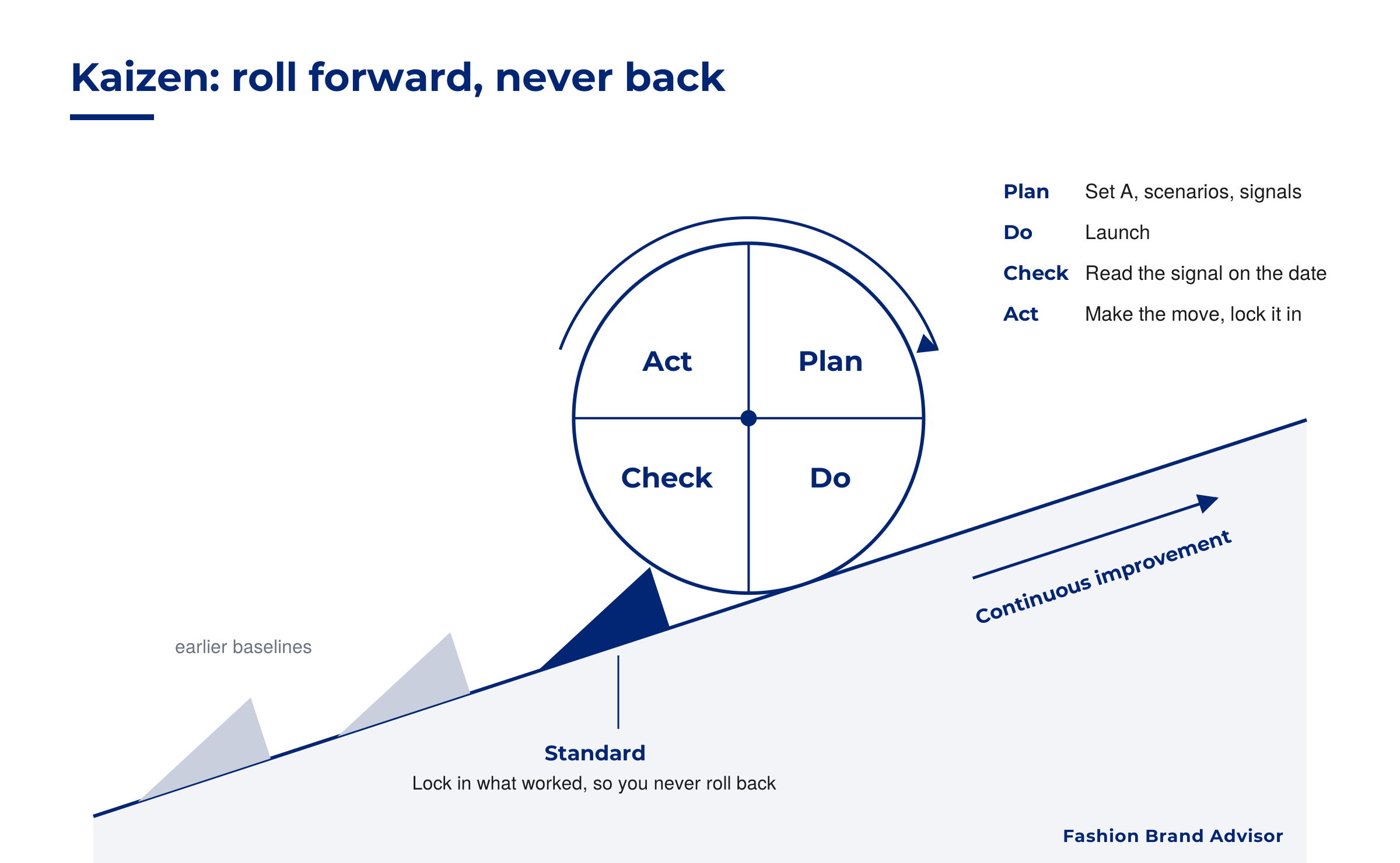
Kaizen runs on a simple loop, and it maps straight onto your scenario plan:
Plan: set A, your likely scenarios and the signal for each.
Do: launch.
Check: read the signal on the date you set.
Act: make the pre-decided move, and lock in what worked as your new baseline.
The two work at different levels. Scenario planning tells you which way to go at a fork. Kaizen is how you move once you're going that way: a better product page this week, a tighter size curve next drop, a lower minimum with your factory next season.
Pivots are rare. Kaizen is every week. Together, they're what turns a run of attempts into a brand.
Discipline isn't just sticking to the plan
"Just do it" gets one thing right: you have to move. Waiting for the perfect plan is its own way of standing still.
But moving isn't the same as progressing. Progress is when each move stands on the one before it.
So plan your scenarios, not your steps. Pivot as often as you need to. Just know why, and know what you're taking with you.
Discipline isn't just sticking to the plan. It's knowing why you change it.
Not sure to get from point A to point B should be? Book a free 15-minute discovery call. We’ll look at where your brand is now and map your next move together.